Most businesses do not have a content problem; they have a strategy problem. They publish when inspiration strikes, on topics that are easy to write about, and then use Predis.ai to create engaging social media content, wondering why traffic does not turn into customers. A content marketing strategy connects what you publish to what your customers need and what your business needs, so every piece has a job.
Quick answer: A content marketing strategy defines the business goal content supports, the audience and their questions at each stage of buying, the topics you will own (organised into pillars and clusters), the formats you will use, a repeatable production workflow, how each piece will be distributed, and how you will measure results in leads and sales, not just traffic.
Step 1: Tie content to a business goal
Start with what the business needs in the next six to twelve months: more qualified leads, more online sales, higher retention, entry into a new market, or recruitment. Content that does not serve a goal is hard to justify and hard to measure. Write the goal down with a number: “Generate 40 qualified enquiries a month from organic search by June.”
Step 2: Understand your audience’s questions
Map the questions customers ask at each stage:
| Stage | Customer mindset | Content that helps |
|---|---|---|
| Awareness | “I have a problem” | Guides, explainers, checklists, how-to videos |
| Consideration | “What are my options?” | Comparisons, case studies, buyer’s guides, tools |
| Decision | “Why this one?” | Pricing pages, demos, testimonials, FAQs, guarantees |
| Retention | “How do I get the most from it?” | Tutorials, tips, community, updates |
Gather real questions from sales calls, support tickets, reviews, social comments and keyword research. The best content ideas usually come from the questions customers ask you directly.
Step 3: Choose topics you can own
Pick three to five core topics where your business has genuine expertise and where content can lead to your products or services. Organise each into a pillar page and supporting cluster articles, linked together with a deliberate internal linking strategy. This builds topical authority and makes each new piece strengthen the others.
On this site, for example, image optimisation is a core topic: the image SEO guide is a pillar supported by articles on formats, alt text and speed, and they link to free tools such as the JPG compressor that solve the reader’s problem directly.
Step 4: Pick formats that fit
- Articles and guides for search and depth.
- Tools, calculators and templates, which attract links and repeat visitors.
- Original research and data, which earns citations from other sites and AI answers.
- Video for demonstrations and personality.
- Visuals and infographics for sharing and quick understanding; see visual content marketing.
- Email newsletters to build a relationship you own.
Choose formats your team can produce consistently. One excellent format done well beats five done poorly.
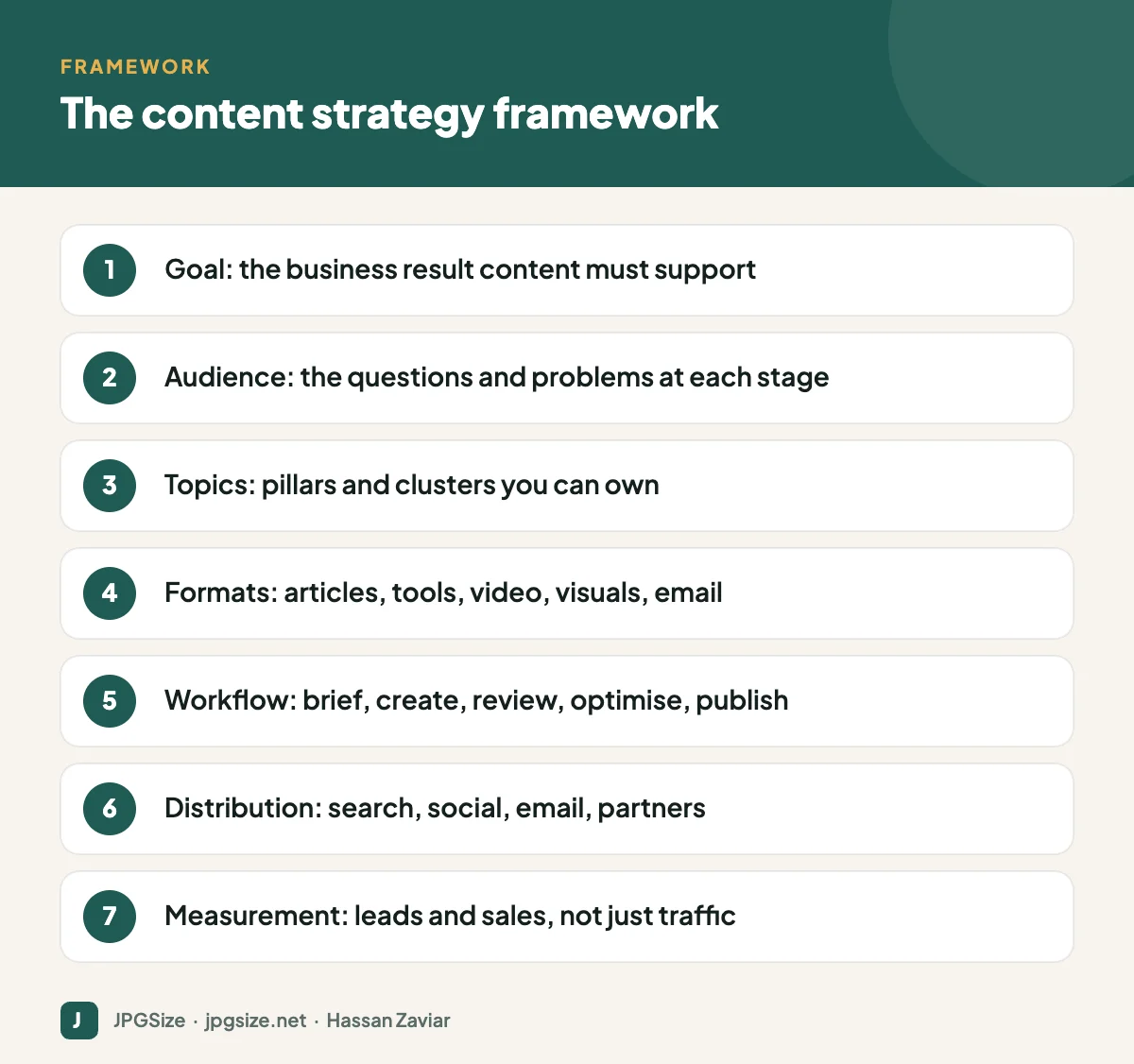
Step 5: Build a repeatable workflow
- Brief: target question, search intent, audience, angle, key points, internal links and call to action.
- Create: write, record or design. AI can help with research and drafts; see how to use AI for SEO content.
- Add evidence: examples, data, screenshots, original photos and expert input. This is what demonstrates E-E-A-T.
- Review: fact-check, edit for clarity and voice, check accessibility.
- Optimise: a direct answer near the top for answer engine optimization, a clear title and meta description, compressed images with alt text.
- Publish and link: add internal links from related existing content.
Step 6: Distribute every piece
Publishing is the midpoint, not the end. For each piece, plan:
- Search: optimised for the query it answers.
- Social: several posts cut from the content, scheduled through your social media content calendar.
- Email or WhatsApp: shared with subscribers who care about the topic.
- Sales and support: sent to customers who ask the question it answers.
- Partners and communities: shared where it genuinely helps.
Step 7: Measure what matters
Track leading indicators (impressions, rankings, traffic, engagement) but judge success on outcomes: enquiries, sign-ups and sales influenced by content. In GA4, set up key events for form submissions and purchases and look at landing pages that start converting sessions; see GA4 for beginners. Review quarterly: update what works, improve what is close and prune or merge what adds nothing.
Refresh before you create
Updating existing content is often the fastest win. Pages ranking on page two, articles with outdated information or posts that get traffic but no conversions can be improved in an afternoon. Add a “last reviewed” date when you update, and fix facts that have changed, such as platform specs in social media image sizes.
A sample content plan for one quarter
Here is how the framework translates into a realistic plan for a small team producing one main piece a week:
| Month | Pillar work | Cluster pieces | Distribution focus |
|---|---|---|---|
| Month 1 | Publish or refresh one pillar guide | 3 articles answering top customer questions | Email the pillar to subscribers; 8 social posts |
| Month 2 | Add a free tool or template linked from the pillar | 3 comparison or how-to articles | Share the tool in communities; short videos |
| Month 3 | Publish one piece of original data or a case study | 2 articles plus 2 refreshes of older posts | Pitch the data to relevant publications |
At the end of the quarter, review which pieces generated enquiries or sales, and shape the next quarter around those topics and formats.
Content marketing mistakes to avoid
- Writing for everyone. Content aimed at “small businesses” in general rarely convinces anyone in particular.
- Chasing traffic unrelated to what you sell. Viral posts that attract the wrong audience do not become customers.
- Publishing without a call to action. Every piece should suggest a sensible next step.
- Neglecting old content. Outdated articles damage trust; schedule regular reviews.
- Copying competitors’ outlines. If your article says what the top ten already say, it has little reason to rank or be cited. Add experience, data or a better format.
Frequently asked questions
What is a content marketing strategy?
It is a plan that connects the content you create to business goals and customer needs, covering audience, topics, formats, production, distribution and measurement.
How often should a small business publish content?
Consistency matters more than volume. One genuinely useful article or video a week, or even every two weeks, supported by distribution, beats daily low-quality posts.
How long does content marketing take to work?
SEO-driven content often takes several months to gain traction, and results compound over time. Distribution through email and social can produce results sooner.
How do I measure content marketing ROI?
Track conversions such as enquiries and sales from content landing pages, assisted conversions, and cost of production, then compare against the value of the leads and sales generated.
Sources and further reading
- Google Search Central: Creating helpful, reliable, people-first content
- Google Search Central: SEO Starter Guide
About the author: Hassan Zaviar writes about image optimization, SEO, AI and digital marketing for JPGSize and works on the site’s free browser-based image tools. Last reviewed: 24 September 2026. Spotted something out of date? Tell us and we will update it.