E-E-A-T stands for Experience, Expertise, Authoritativeness and Trustworthiness. It comes from the guidelines Google gives to its human search quality raters, and it describes the kind of content Google’s ranking systems are designed to reward. It is not a score you can check, but it is a very useful lens for improving content.
Quick answer: E-E-A-T is Google’s framework for judging content quality: first-hand Experience, subject Expertise, Authoritativeness (recognition by others) and Trustworthiness, which Google calls the most important. You demonstrate it with named authors and bios, original evidence such as your own photos and tests, cited sources, transparent about and contact pages, accurate dates and a secure, honest website.
What each letter means
| Letter | Question it answers | How to show it |
|---|---|---|
| Experience | Has the creator actually used, done or visited the thing? | Original photos, screenshots, test results, personal observations |
| Expertise | Does the creator have the knowledge or skill needed? | Author bios, credentials, depth and accuracy of the content |
| Authoritativeness | Is the creator or site a recognised go-to source? | Mentions, links and citations from respected sites; reviews |
| Trustworthiness | Is the page accurate, honest, safe and reliable? | Sources, transparency, contact details, security, correct information |
Google added the extra “E” for Experience in December 2022. It recognises that for many topics, such as product reviews or travel, someone who has actually done the thing can be more useful than someone with formal qualifications.
Is E-E-A-T a ranking factor?
Not directly. Google has said that E-E-A-T itself is not a specific ranking factor, and quality raters do not change rankings for individual sites. Their ratings help Google evaluate whether its algorithms are working. However, Google uses many signals that align with E-E-A-T, and its helpful content guidance asks site owners to evaluate their content in exactly these terms. In practice, improving E-E-A-T and improving your chances of ranking are closely linked.
YMYL topics need more
“Your Money or Your Life” (YMYL) topics can affect health, financial stability, safety or society: medical advice, investing, legal information, news. For these, Google’s raters apply much stricter standards, and formal expertise matters more. If you publish YMYL content, have it written or reviewed by qualified people and say so on the page.
How to demonstrate Experience
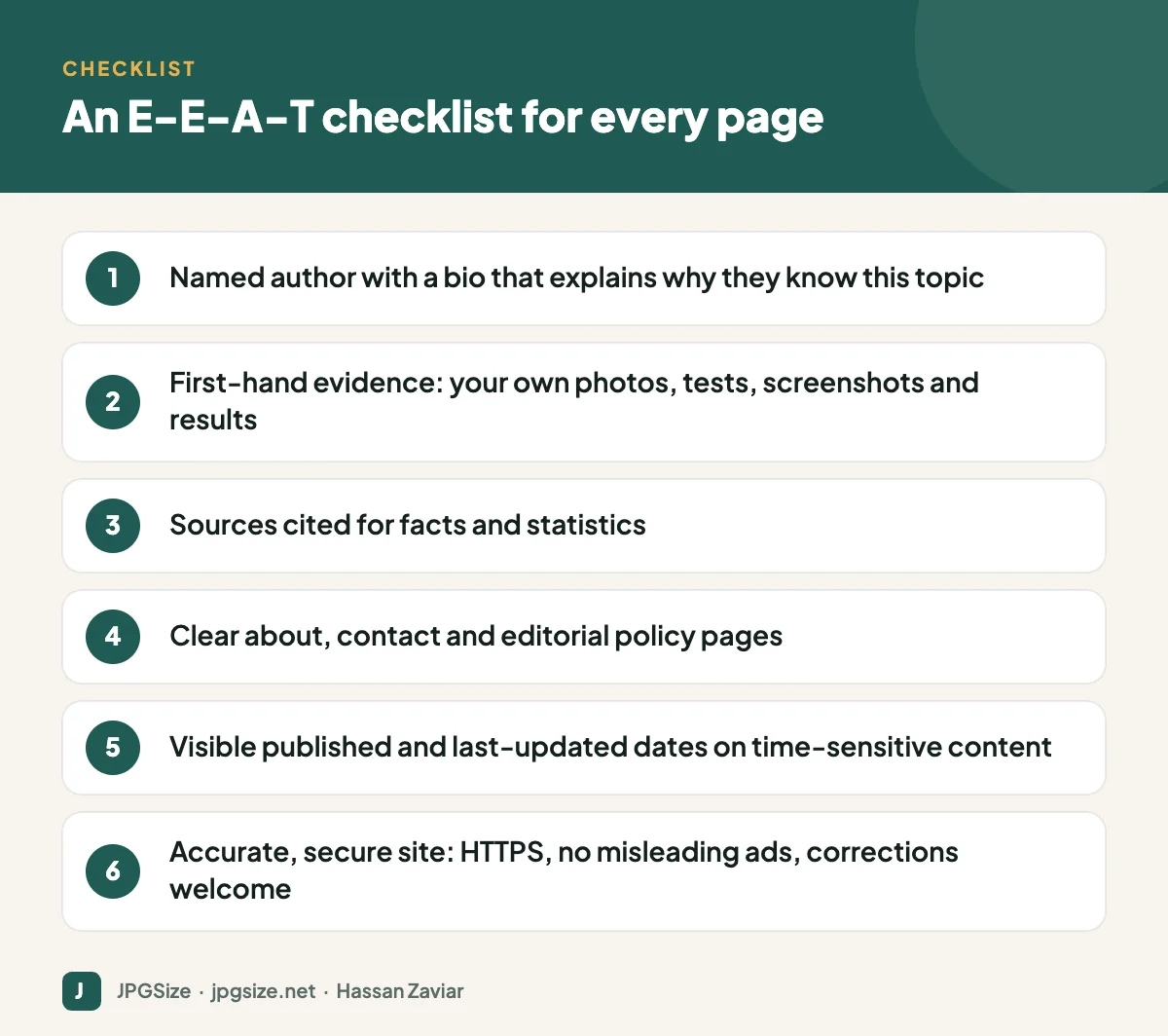
- Use original images. Photos you took, screenshots from your own accounts and charts from your own data are strong signals that you have done the work. Stock images signal the opposite. Our tools help you resize and compress them for the web.
- Show results and process. “We encoded three test photos with Pillow 12.3 and measured file sizes” is more credible than “WebP is smaller”. See how we did it in WebP vs AVIF vs JPEG.
- Share specifics only a practitioner would know, such as the error message a form actually shows, or a mistake you made and fixed.
How to demonstrate Expertise
- Put a named author on every article with a short bio explaining their relevant background, linked to an author page.
- Go deeper than competing pages: answer follow-up questions, explain trade-offs and cover edge cases.
- Get accuracy right. Outdated specifications and wrong numbers undermine expertise quickly.
How to build Authoritativeness
Authority is largely what others say about you, so it takes time:
- Earn links and mentions from respected sites in your field by publishing original data, tools and genuinely useful resources.
- Build a consistent presence where your audience spends time, such as LinkedIn, YouTube or industry communities. Our LinkedIn image sizes guide helps make those profiles look professional.
- Collect reviews on independent platforms, and keep your Google Business Profile complete if you serve local customers.
- Build topical depth with clusters of related content, connected by a sensible internal linking strategy.
How to build Trust
Google describes trust as the most important member of the E-E-A-T family. Untrustworthy pages have low E-E-A-T no matter how expert they seem.
- Transparency: an about page explaining who runs the site and why, and a working contact page.
- Accuracy: cite sources for statistics and claims, and correct errors promptly. Adding “Spotted something out of date? Tell us” to articles invites corrections.
- Dates: show when content was published and last reviewed, especially for time-sensitive topics.
- Security and honesty: HTTPS, clear privacy policy, no deceptive design or misleading ads, and disclosure of affiliate relationships and AI assistance where relevant.
E-E-A-T and AI-generated content
Google’s position is that it rewards helpful content however it is produced, but content made mainly to manipulate rankings violates its spam policies. AI tools can speed up research and drafting, but they cannot supply first-hand experience. The safest approach is to use AI as an assistant and make sure every page includes human judgment, original evidence and a named, accountable author. Read how to use AI for SEO content for a workflow.
A quick E-E-A-T audit for your site
- Pick your ten most important pages.
- For each, ask: who wrote this, and does the page say why they are qualified?
- Is there anything on the page that proves first-hand experience?
- Are facts and numbers sourced and still accurate?
- Can a visitor easily find who runs the site and how to contact them?
- Would you trust this page with your own money, health or time?
Fix the gaps on those ten pages first, then roll the changes into your templates so every new article gets them automatically.
E-E-A-T for small websites
Small sites sometimes assume E-E-A-T is only achievable for big brands. In practice, small, focused sites can demonstrate it very convincingly because the people behind them are usually closer to the work. A local accountant who explains a tax change with examples from real (anonymised) client situations, or a tool maker who shows exactly how the tool was tested, shows more first-hand experience than a generic article on a large site.
Focus on a narrow topic, publish evidence of your own work, put your name and face on it, and make it easy to contact you. Those signals compound over time as other sites start to reference you.
Frequently asked questions
What does E-E-A-T stand for?
Experience, Expertise, Authoritativeness and Trustworthiness. It is the framework Google’s search quality raters use to evaluate content quality.
Is E-E-A-T a Google ranking factor?
Not as a single measurable factor. Google uses a mix of signals that align with E-E-A-T, so improving these qualities generally supports better rankings.
Do I need author bios for SEO?
Author bios are one of the clearest ways to show expertise and accountability. They are especially important for advice, reviews and YMYL topics.
Can AI-written content have good E-E-A-T?
AI can help produce content, but experience and accountability come from people. Content with human review, original evidence and a named author is far more likely to meet the standard.
Sources and further reading
- Google Search Central: Creating helpful, reliable, people-first content
- Google Search Central Blog: Our latest update to the quality rater guidelines (E-E-A-T)
- Google Search Quality Rater Guidelines (PDF)
About the author: Hassan Zaviar writes about image optimization, SEO, AI and digital marketing for JPGSize and works on the site’s free browser-based image tools. Last reviewed: 24 September 2026. Spotted something out of date? Tell us and we will update it.