Search is no longer only ten blue links. Google shows featured snippets and AI Overviews, people ask Siri and Alexa, and a growing number of searches happen inside ChatGPT, Perplexity and Gemini. Answer engine optimization (AEO) is the practice of structuring content so these systems can pick it as the answer.
Quick answer: Answer engine optimization means writing and structuring content so search engines and AI assistants can extract a direct answer from it. In practice: target real questions, answer each one clearly in the first 40 to 60 words under a question-style heading, support it with detail and evidence, use structured data honestly, and build trust with named authors and sources.
AEO vs SEO vs GEO
The terms overlap, and most of the work is shared. A useful way to separate them:
| SEO | AEO | GEO | |
|---|---|---|---|
| Goal | Rank pages in search results | Be selected as the direct answer | Be cited or mentioned in AI-generated responses |
| Typical surfaces | Organic results | Featured snippets, People Also Ask, voice assistants | AI Overviews, AI Mode, ChatGPT, Perplexity, Gemini |
| Unit of content | Page | Passage or answer | Facts, entities and passages across many sources |
| Key signals | Relevance, links, experience | Clear question-answer structure | Clarity, authority, consistency across the web |
AEO sits in the middle. If your content is easy to extract answers from, it tends to perform better in classic SEO too, and it lays the groundwork for generative engine optimization (GEO).
Why AEO matters now
Google reported in 2025 that AI Overviews were used by more than two billion people a month, and it has expanded AI Mode to many countries and languages, including India. Voice assistants read one answer, not ten. When an answer engine gives the user a single response, being the source of that response matters more than being fourth on a list.
There is a trade-off worth being honest about: some answer surfaces satisfy the searcher without a click. AEO is still worth doing, because being cited builds brand recognition, and people who do click through from a cited answer tend to be further along in their decision.
How to do AEO: a step-by-step process
1. Collect the questions
Start with the questions your audience actually asks, in their words:
- Google’s People Also Ask boxes and autocomplete suggestions for your main topics.
- Support emails, chat logs and sales calls.
- Reddit, Quora and niche forums.
- Keyword tools filtered for question words (what, how, why, can, does, is). Our keyword research for beginners guide covers the basics.
Group questions by intent. “What size should a passport photo be?” and “passport photo dimensions in cm” belong on the same page.
2. Put the question in a heading, and the answer right under it
Use the question, or a close version of it, as an H2 or H3. Then answer it in the first sentence or two, in roughly 40 to 60 words, without preamble. This is the passage most likely to be lifted into a featured snippet or quoted by an AI system. Every article on this site opens with a “Quick answer” box for exactly this reason.
3. Expand with structure
After the short answer, add the detail a person actually needs: numbered steps for processes, tables for comparisons and specifications, and bullet lists for options. Answer engines like structured content because it maps cleanly onto list and table snippets.
4. Be specific and verifiable
“Instagram portrait posts should be 1080 x 1350 pixels (4:5)” is far more useful to an answer engine than “use a tall image”. Specific numbers, named standards and cited sources make an answer both extractable and trustworthy.
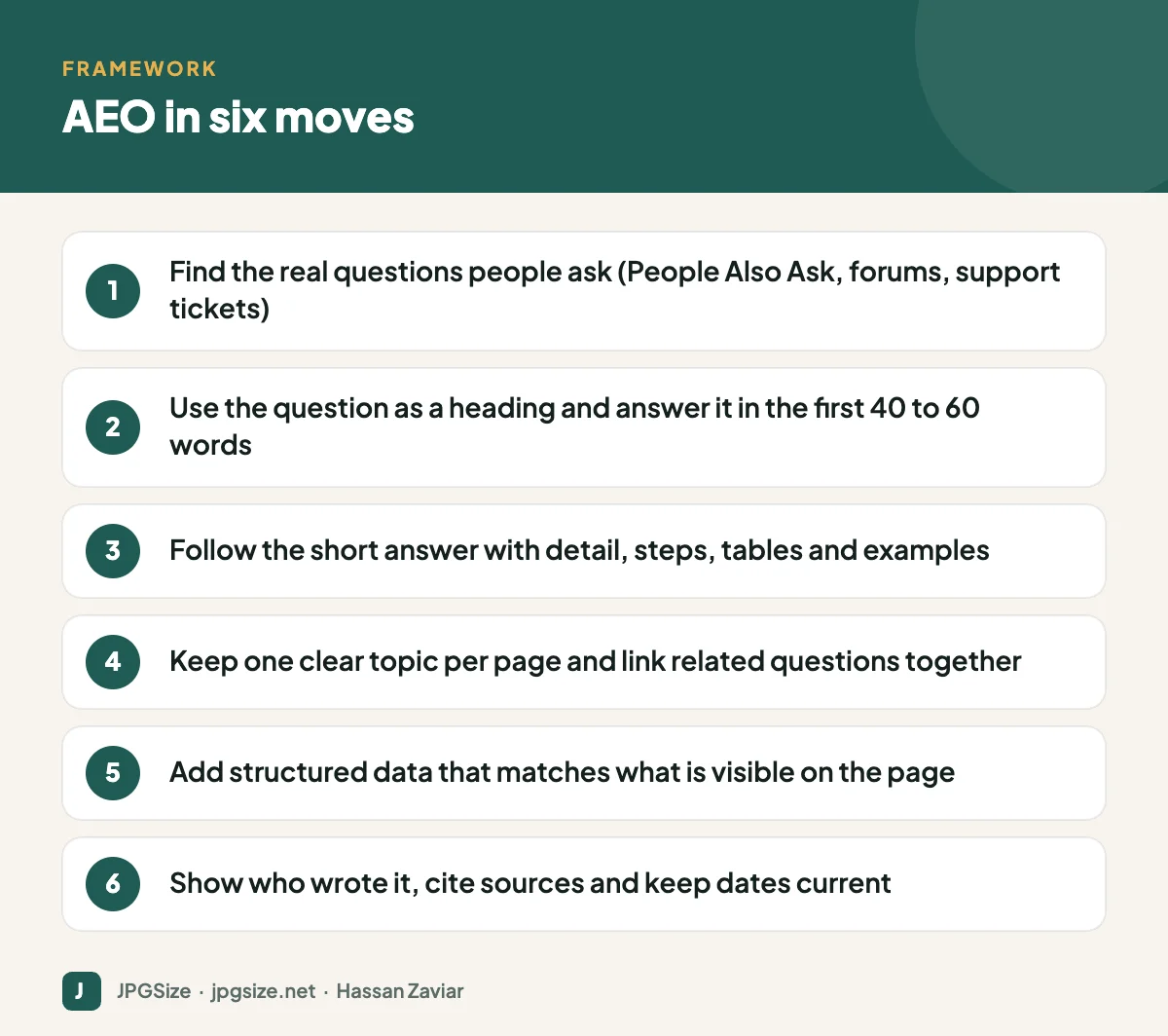
5. Use structured data that matches the page
Schema markup does not guarantee a rich result, but it helps machines understand the content. Relevant types include Article, FAQPage, HowTo-style content in plain HTML, Product, and Organization. Note that Google limited FAQ rich results in 2023 to well-known, authoritative government and health sites, so do not add FAQ schema expecting stars and dropdowns in results. It can still help other systems parse your content, as long as the questions and answers are visible on the page. See structured data for images for schema examples.
6. Build trust signals
Answer engines are more likely to rely on content that looks trustworthy: a named author with relevant experience, an about page, contact details, sources, and a visible last-updated date. Read E-E-A-T explained for a checklist.
7. Connect related answers
Link related questions together so both people and crawlers can follow the topic. A cluster of pages that answers every question around a subject signals depth. Our internal linking strategy guide shows how to structure this.
AEO for voice search
Voice answers are usually short, spoken in full sentences and drawn from pages that already rank well. Keep answers conversational, include the question’s key terms naturally, and make sure your pages load fast on mobile. For local businesses, a complete and accurate Google Business Profile is often the source for “near me” voice answers.
How to measure AEO
- Featured snippets and People Also Ask: most rank trackers flag which keywords show a snippet and whether you own it.
- Search Console: watch impressions and clicks for question queries; rising impressions with flat clicks can indicate zero-click answers.
- AI citations: manually check your key questions in AI Overviews, ChatGPT and Perplexity, or use brand-monitoring tools that track AI mentions.
- Brand search volume: if more people search for your brand by name, your answers are being noticed.
Common AEO mistakes
- Burying the answer under a long introduction.
- Writing vague answers to avoid being “too short”.
- Stuffing pages with FAQ sections unrelated to the main topic.
- Marking up content with schema that is not visible to users.
- Letting facts go out of date, which is especially damaging for sizes, prices and specifications.
Frequently asked questions
Is AEO different from SEO?
AEO is a specialised part of SEO. It focuses on making specific passages easy to extract as direct answers, while SEO covers everything that helps whole pages rank, including technical health and links.
How long should an answer be for a featured snippet?
A direct answer of about 40 to 60 words works well for paragraph snippets. Follow it with lists or tables for more detail, which can also be pulled into list and table snippets.
Does FAQ schema still help?
Google shows FAQ rich results only for a limited set of authoritative government and health sites. FAQ markup can still help machines understand your content, but it will not produce rich results for most sites.
Can small websites win answer boxes?
Yes. Answer boxes often go to pages that answer the specific question most clearly, not necessarily the biggest brand. Niche, well-structured pages regularly win snippets.
Sources and further reading
- Google Search Central: AI features and your website
- Google Search Central: Featured snippets
- Google Search Central: Changes to HowTo and FAQ rich results (2023)
- Google Search Central: Creating helpful, reliable, people-first content
About the author: Hassan Zaviar writes about image optimization, SEO, AI and digital marketing for JPGSize and works on the site’s free browser-based image tools. Last reviewed: 24 September 2026. Spotted something out of date? Tell us and we will update it.