When someone asks Google’s AI Mode, ChatGPT or Perplexity a question, the answer is written by a language model that pulls information from several web pages. Some of those pages are cited with a link; most are not mentioned at all. Generative engine optimization (GEO) is about making your pages the ones that get used and credited.
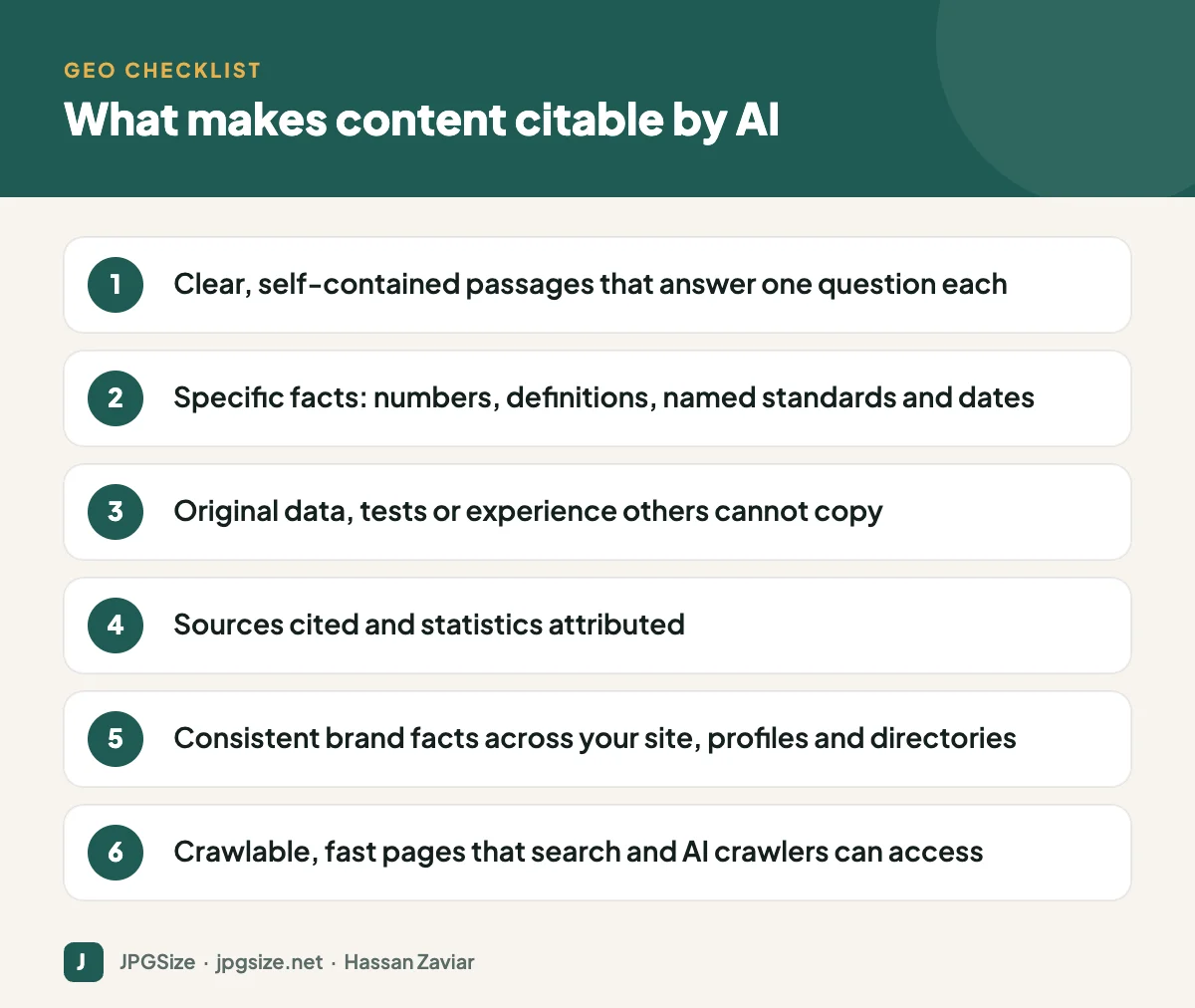
Quick answer: Generative engine optimization (GEO) is optimizing content so AI search systems cite or mention it in their generated answers. The most reliable tactics are the fundamentals done well: crawlable pages, clear self-contained answers, specific facts and statistics with sources, original data or first-hand experience, strong E-E-A-T signals, and consistent information about your brand across the web.
Where the term comes from
The phrase was popularised by a 2023 research paper from Princeton University, Georgia Tech, the Allen Institute for AI and IIT Delhi titled GEO: Generative Engine Optimization. The researchers tested content changes on a benchmark of queries and found that adding citations, quotations from relevant sources and statistics increased how visible a source was in generated answers by up to around 40% in their experiments, while keyword stuffing did not help. Real AI search products differ from a research benchmark, but the direction of the findings matches what practitioners report.
How AI search chooses sources
Most AI search features use a process called retrieval-augmented generation. Simplified:
- The system turns the user’s question into one or more search queries (Google calls this “query fan-out” in AI Mode).
- It retrieves candidate pages from a search index.
- It picks passages from those pages that answer parts of the question.
- The model writes an answer and, depending on the product, links to some of the sources.
Two implications follow. First, you usually need to be retrievable by normal search to be cited, so SEO still matters. Second, selection happens at the passage level, so a page with one clear, quotable paragraph can be cited even if the rest of the page is long.
Google’s own guidance for AI features says there are no special requirements beyond normal SEO best practice: pages must be indexed and eligible to show a snippet, and helpful, people-first content is what it wants to surface.
GEO tactics that work
Write quotable passages
Each section should make sense on its own. Start with a one- or two-sentence answer, name the subject explicitly rather than saying “it”, and avoid relying on context from earlier in the page. This is the same discipline described in our answer engine optimization guide.
Include specific, sourced facts
Language models prefer concrete information they can state confidently. Replace “images should be compressed” with “most content images can be compressed to between 60 KB and 200 KB”. Cite where numbers come from. When you have run your own test, such as our WebP vs AVIF vs JPEG comparison, describe the method so the result is credible.
Publish something original
If your page says the same thing as fifty others, a generative engine has no reason to prefer it. Original data, case studies, tools, templates, photos and first-hand experience give it one. This also aligns with Google’s emphasis on experience in E-E-A-T.
Build entity clarity
AI systems reason about entities: your brand, your authors, your products. Make sure the basics are consistent everywhere: the same business name, description, address and founder information on your website, social profiles, Google Business Profile and directory listings. Organization and Person structured data on your about page helps connect the dots.
Earn mentions, not only links
AI answers draw on reviews, forums, news and comparison articles, not only your own site. Being mentioned positively on respected third-party sites, podcasts and communities increases the chance that your brand is included when a model summarises a topic.
Keep content fresh
Specifications, prices and platform rules change. A page with an accurate, recent date and up-to-date numbers is safer for an AI system to cite than an old one. Our social media image sizes cheat sheet, for example, needs checking whenever platforms change their layouts.
Stay accessible to crawlers
Check that robots.txt does not accidentally block search engine crawlers, that important content is in the HTML rather than hidden behind scripts or logins, and that pages load quickly. Decide deliberately whether to allow AI-specific crawlers such as GPTBot or Google-Extended based on your business goals; blocking Google-Extended does not remove you from Google Search.
What does not work
- Keyword stuffing and “prompt injection” text aimed at AI systems. It is spam and can get pages penalised.
- Mass-produced AI pages with no original value. Google’s spam policies target scaled content abuse regardless of how the content is made. See using AI for SEO content.
- Chasing every new acronym. GEO, AEO, LLMO and AIO describe overlapping ideas. The fundamentals are the same.
How to measure GEO
Measurement is still immature, so combine several signals:
- Manually test your important questions in Google AI Overviews and AI Mode, ChatGPT search, Perplexity and Gemini, and record whether you are cited.
- Watch referral traffic from AI tools in GA4; sources such as chatgpt.com and perplexity.ai appear in the traffic acquisition report. Our GA4 for beginners guide shows where to look.
- Track branded search volume and direct traffic over time.
- Use SEO platforms that now monitor AI citations and brand mentions.
A GEO audit you can run this week
- List 20 questions your customers ask before buying, in their own words.
- Ask each question in Google AI Mode, ChatGPT search and Perplexity. Record which sources are cited and whether your brand is mentioned.
- Compare your pages with the cited sources. Do they answer the question more directly, include more specific facts, or show more evidence of experience?
- Fix the gaps: add a clear answer paragraph, a table or list of specifics, sources and an author bio where missing.
- Strengthen off-site signals: make sure your brand facts are consistent on your profiles, and look for relevant publications, podcasts or communities where your expertise would be useful.
- Repeat the check monthly and note changes. AI answers vary between sessions, so look for trends rather than single results.
Frequently asked questions
Is GEO replacing SEO?
No. Most AI search systems retrieve sources through search indexes, so strong SEO is a prerequisite. GEO adds a focus on quotable passages, facts, originality and brand consistency.
How do I get my website cited by ChatGPT?
Make sure your pages are crawlable and rank for related searches, answer questions clearly and specifically, include original data or experience, and build mentions on trusted third-party sites. There is no way to pay for or request citations.
Does schema markup help with AI search?
Structured data helps search engines understand entities and page content, which supports AI features indirectly. It is not a guarantee of citation, and it must match the visible content.
Should I block AI crawlers?
It depends on your goals. Blocking AI training crawlers may protect content, but it can reduce visibility in some AI products. Blocking Google-Extended does not affect your ranking or inclusion in Google Search.
Sources and further reading
- Aggarwal et al., GEO: Generative Engine Optimization (arXiv, 2023)
- Google Search Central: AI features and your website
- Google Search Central: Spam policies
About the author: Hassan Zaviar writes about image optimization, SEO, AI and digital marketing for JPGSize and works on the site’s free browser-based image tools. Last reviewed: 24 September 2026. Spotted something out of date? Tell us and we will update it.