An AI assistant answers questions. An AI agent takes actions: it can plan a series of steps, use tools such as a browser, spreadsheet or ad platform, check its own progress and keep going until a goal is reached. Agents are among the most discussed developments in marketing technology, and also among the most overhyped. Here is a practical view.
Quick answer: AI agents are AI systems that can plan and carry out multi-step tasks using tools, with limited human input. In marketing they are useful today for research, data gathering, reporting, content operations and drafting campaign assets. They still make mistakes, can take unintended actions and need clear goals, restricted permissions, human approval for spending or publishing, and full logging.
What makes something an agent?
The word is used loosely, but an agent usually has four abilities:
- A goal rather than a single instruction (“compile a competitor pricing report” rather than “summarise this page”).
- Planning: breaking the goal into steps.
- Tool use: browsing websites, calling APIs, reading and writing files, using software.
- Iteration: checking results, correcting mistakes and continuing until done or stuck.
Chat assistants increasingly include agent-like modes, workflow platforms let you build agents from components, and marketing software vendors are adding agents for specific jobs such as campaign optimisation or lead research.
Realistic marketing use cases today
Research and competitive intelligence
Agents can visit competitor websites, collect pricing and feature information into a table, summarise recent announcements and gather reviews. This is a strong fit because the output is a report a human reviews.
Reporting
An agent can pull data from analytics and ad platforms, build a weekly report, highlight changes and draft commentary. Pair this with correct tracking; see GA4 for beginners.
Content operations
Agents can take an approved article and produce drafts for social posts, email snippets and image variations, then place them in your content calendar for approval. They can also check published pages for broken links, missing alt text and outdated dates, supporting your internal linking and image SEO work.
Lead research
Given a target profile, agents can research companies, find public information relevant to outreach and prepare notes for sales. Respect data protection rules and website terms when collecting information.
Campaign setup drafts
Some agents can draft ad campaign structures, keyword lists and ad copy variations inside ad platforms. Keep them in draft mode until a person reviews targeting, budgets and claims.
What agents still struggle with
- Reliability over long tasks. Small errors compound across many steps. An agent can confidently finish a task that went wrong at step three.
- Judgment and taste. Choosing the right strategy, the right creative or the right tone for a sensitive situation still needs people.
- Unfamiliar interfaces. Agents that operate websites can be confused by pop-ups, logins, CAPTCHAs and layout changes.
- Security. Agents that read web pages or emails can be manipulated by hidden instructions in that content, known as prompt injection. An agent with access to your ad account or inbox is an attractive target.
- Cost control. Agents can use many AI calls and tool actions; costs need monitoring.
Guardrails that make agents safe to use
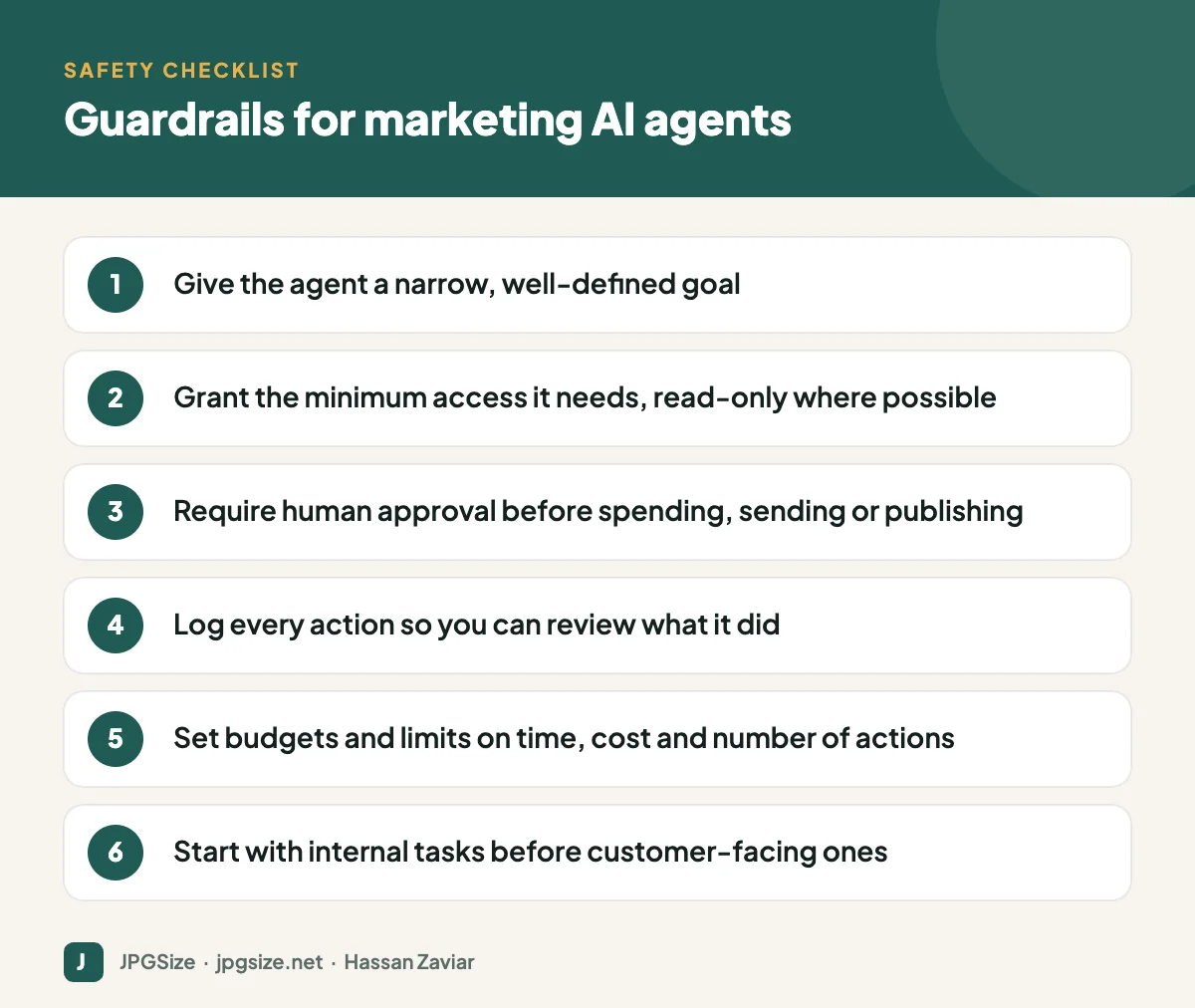
- Narrow goals. “Summarise competitor pricing pages listed in this sheet” is safer and more reliable than “improve our marketing”.
- Least privilege. Give read-only access wherever possible. Do not give an agent your admin passwords or payment details.
- Human approval gates before anything is sent, published, purchased or changed in live campaigns.
- Logging and review. Keep a record of every action and output.
- Limits: caps on spending, number of actions and time.
- Separation from untrusted content. Be cautious about agents that both read external content (emails, web pages) and have the power to act on your accounts.
How to pilot an agent
- Pick one internal, repetitive, research-style task, such as a weekly competitor summary.
- Define what good output looks like with an example.
- Run the agent alongside your current process for four weeks, reviewing every output.
- Track time saved, error rate and cost.
- Expand scope only when results are consistently good.
This mirrors the rollout plan in our AI marketing automation guide. For the fundamentals of briefing any AI system, see prompt engineering for marketers.
Agents and search: a new kind of visitor
Agents are not only tools for marketers; they are also becoming visitors to your website. AI assistants may browse on behalf of users to compare products or complete tasks. Clear, well-structured pages with accurate information, fast loading and accessible forms make it easier for both people and agents to understand your offer. The same principles behind generative engine optimization apply.
Agents vs automations: which do you need?
Many tasks described as needing an “agent” are better served by a simple automation. Use this rule of thumb:
| Choose a workflow automation when… | Consider an agent when… |
|---|---|
| The steps are the same every time | The steps depend on what is found along the way |
| Inputs are structured (forms, spreadsheets) | Inputs are messy (web pages, documents, emails) |
| Errors must be near zero | A human will review the result anyway |
| Volume is high and cost per run matters | Tasks are occasional and time-consuming for people |
For example, sending a welcome email when someone signs up is an automation. Researching twenty potential partner companies and summarising why each might be a fit is a good agent task, because every company requires different searching and reading.
A simple example agent brief
Here is the kind of brief that works well for a first agent pilot: “Every Monday, visit the pricing pages of the five competitors listed in the shared sheet. Record plan names, monthly prices and any changes since last week in the sheet. Write a five-bullet summary of notable changes. Do not log in to any site, submit any form or contact anyone. If a page cannot be read, note it and move on.” The goal is narrow, the permissions are limited, the output is reviewable and the forbidden actions are explicit.
Frequently asked questions
What is an AI agent in marketing?
It is an AI system that can plan and complete multi-step marketing tasks using tools, such as researching competitors, building reports or drafting campaign assets, with limited human input.
Can AI agents run my ad campaigns?
They can help draft and optimise campaigns, and ad platforms already use automation heavily. Keep human approval for budgets, targeting and creative, and monitor results closely.
Are AI agents safe to use?
They can be, with narrow goals, minimal permissions, approval steps and logging. Risks include errors, unintended actions and manipulation through malicious content they read.
Will AI agents replace marketing teams?
They will change how teams work by taking on research, reporting and production tasks. Strategy, creativity, relationships and accountability remain human responsibilities.
Sources and further reading
- OWASP: Top 10 for Large Language Model Applications
- UK NCSC: Guidelines for secure AI system development
About the author: Hassan Zaviar writes about image optimization, SEO, AI and digital marketing for JPGSize and works on the site’s free browser-based image tools. Last reviewed: 24 September 2026. Spotted something out of date? Tell us and we will update it.