The difference between generic AI output and genuinely useful marketing copy is rarely the tool. It is the brief. Prompt engineering sounds technical, but for marketers it is mostly the skill you already have: writing a clear creative brief with the context, audience, constraints and examples someone needs to do great work.
Quick answer: A strong marketing prompt includes a role, a specific task, rich context (audience, product, offer, brand voice and constraints), one or two examples of good output, and the exact format you want back. Then iterate: ask for options, critique them against your criteria and refine. Save prompts that work as templates in a shared library.
Why most marketing prompts disappoint
“Write a LinkedIn post about our new product” gives the model almost nothing to work with. It does not know the product, the audience, the tone, the goal or what makes your brand different, so it fills the gaps with the most average possible answer. The output is not wrong; it is generic.
Good prompts reduce guesswork. Every piece of context you add removes a decision the model would otherwise make for you.
The RTCEF framework
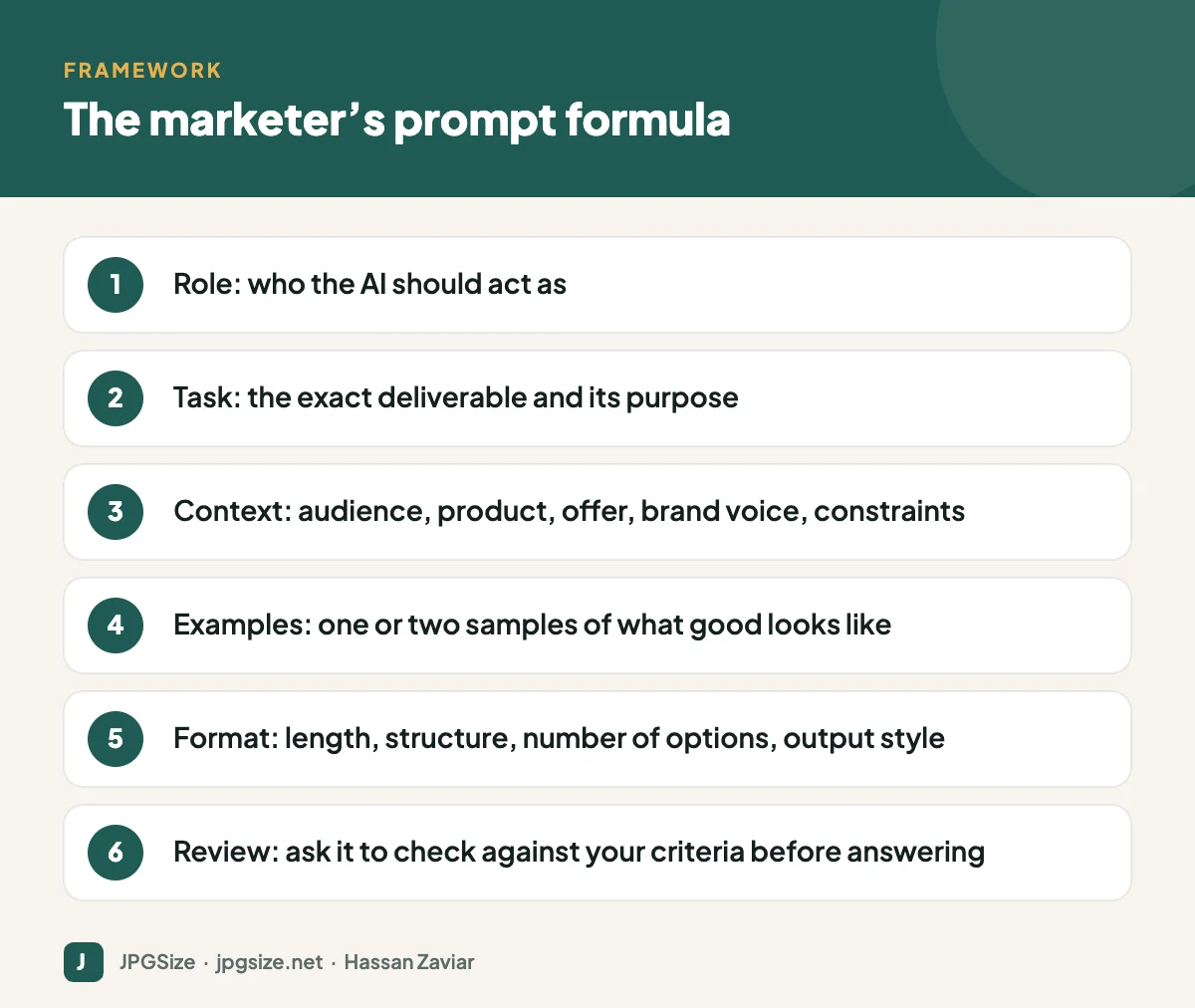
A simple way to remember the ingredients is Role, Task, Context, Examples, Format.
Role
Tell the model what perspective to take: “You are a senior B2B copywriter who writes for finance directors.” Roles are not magic, but they steer vocabulary, tone and priorities.
Task
State the deliverable precisely, including its purpose. “Write three LinkedIn post drafts announcing our invoice automation feature, aimed at getting demo sign-ups.”
Context
This is where most of the quality comes from. Include:
- Audience: who they are, what they care about, what they already know.
- Product and offer: features, benefits, proof points, price or promotion.
- Brand voice: three adjectives, words to use and avoid, reading level.
- Constraints: length, compliance rules, claims you cannot make, calls to action.
- Source material: paste the product sheet, customer quotes or research you want it to use.
Examples
One or two examples of work you like (for tone and structure) are worth paragraphs of description. Label them clearly as examples so the model does not copy them.
Format
Say exactly how you want the answer: “Return three options, each under 150 words, with a hook line, two short paragraphs and one call to action. Put a one-sentence rationale under each.”
Before and after: a real example
Weak prompt: Write an email about our summer sale.
Strong prompt: You are an email copywriter for an online shop selling handmade leather bags to professionals aged 28 to 45. Write a promotional email for our summer sale: 20% off all laptop bags until 31 July, free delivery over 5,000 rupees. Our voice is warm, confident and understated; avoid exclamation marks, “hurry” and “don’t miss out”. Our best-performing past email used short paragraphs and one customer quote. Include: three subject line options under 45 characters, a preview text line, a body under 150 words using this customer quote: “Two years of daily commuting and it still looks new.” End with one button label. Then list any claims I should verify before sending.
The second prompt takes two minutes longer to write and saves twenty minutes of editing.
Prompts for marketing images
Image prompts need different context: subject, setting, composition, lighting, style, colour palette and the final use. For example: “Product photo of a tan leather laptop bag on a light oak desk beside a closed laptop and a coffee cup, soft morning window light from the left, shallow depth of field, neutral warm tones, 4:5 vertical composition with empty space at the top for a headline.” Mentioning the aspect ratio for the destination saves resizing later; our social media image sizes guide lists the right ratios. For tool selection, see how to choose an AI image generator.
Techniques that consistently improve output
- Ask for options, not answers. Five headlines let you pick and combine; one headline invites settling.
- Ask it to critique itself. “Review your drafts against the brief and our voice rules, then improve the weakest one.”
- Break big tasks into steps. Outline first, approve it, then draft section by section.
- Give it your data. Paste real reviews, survey answers or analytics exports and ask for patterns. Remove personal data first.
- Ask what is missing. “What information would help you write a better version?” often surfaces gaps in your brief.
- Set guardrails for facts. “Only use statistics from the text I provided. If you are unsure, say so.”
Prompt templates for common marketing tasks
| Task | Key context to include |
|---|---|
| Ad copy variations | Platform and character limits, audience segment, offer, proof point, banned claims |
| Blog outline | Target keyword, search intent, audience expertise, competitor gaps, internal links |
| Social captions | Platform, post format, voice examples, hashtags policy, CTA |
| Customer research summary | Raw reviews or survey text, questions to answer, output as themes with quotes |
| Landing page review | Page copy, audience, conversion goal, ask for friction points and fixes |
| Analytics explanation | Export or screenshot description, business question, ask for next actions |
For blog content specifically, pair these prompts with the workflow in how to use AI for SEO content.
Build a team prompt library
Once a prompt reliably works, save it. A shared document or workspace with named templates, such as “Product launch email v3”, helps everyone start from proven briefs. Include the brand voice section as a reusable block, note which tool and settings were used, and review templates quarterly as models change. This turns individual tricks into a team capability, which is also the foundation for AI marketing automation.
What not to put in prompts
- Customer personal data, passwords, financial details or confidential plans in tools that are not approved for business data.
- Requests to imitate a living person’s identity or a competitor’s protected creative work.
- Instructions to invent reviews, testimonials or statistics.
Frequently asked questions
What is prompt engineering in marketing?
It is the practice of writing clear, detailed instructions for AI tools so they produce useful marketing output. In practice it is very similar to writing a good creative brief.
What makes a good AI prompt?
A clear role and task, detailed context about the audience, product and brand voice, examples of good output and a precise format for the answer.
Do prompts work the same in every AI tool?
The principles are the same, but results differ between models. Test important prompts in the tool you actually use and adjust the wording.
How long should a prompt be?
As long as it needs to be. For quick tasks, two sentences may do. For campaign work, a few hundred words of context and examples is normal and usually saves editing time.
Sources and further reading
- OpenAI: Prompt engineering guide
- Anthropic: Prompt engineering overview
- Google: Gemini prompting strategies
About the author: Hassan Zaviar writes about image optimization, SEO, AI and digital marketing for JPGSize and works on the site’s free browser-based image tools. Last reviewed: 24 September 2026. Spotted something out of date? Tell us and we will update it.