AI image generators make it easy to create campaign visuals in minutes. The legal questions are less simple: can you use those images in ads and on products, does anyone own them, and could they infringe someone else’s rights? The answers depend on where you are, which tool you used and how much human creativity went into the final image.
Quick answer: In most cases you can use AI-generated images commercially if the tool’s terms allow it, but you may not own a copyright in them. In the United States, purely AI-generated images are not protected by copyright because copyright requires human authorship; human-created elements, selection, arrangement and substantial editing can be protected. The bigger practical risks are outputs that resemble existing copyrighted works, trademarks or real people.
This article is general information, not legal advice. Laws differ between countries and are changing quickly.
Two separate questions
People often mix up two different issues:
- Permission to use: Are you allowed to use the image commercially? This is mostly governed by the AI tool’s terms of service and by the rights of anyone whose work, brand or likeness appears in the output.
- Ownership and protection: Can you stop others from copying the image? That depends on whether the image is protected by copyright, which depends on the law of the country.
You can have the first without the second: a tool may let you use an image in ads, while nobody, including you, holds a copyright in it.
The United States: human authorship is required
The U.S. Copyright Office has consistently said it will register only works with human authorship. Key points:
- In 2023, it partially cancelled the registration of the comic book Zarya of the Dawn: the human-written text and the selection and arrangement of images were protected, but the individual images generated with Midjourney were not.
- In January 2025, its report on copyrightability concluded that prompts alone generally do not give users enough control over the output to make them the author, while human expressive contributions, creative selection and arrangement, and meaningful modifications can be protected.
- In Thaler v. Perlmutter, courts upheld the refusal to register an image created autonomously by an AI system. The D.C. Circuit affirmed in March 2025, and in March 2026 the U.S. Supreme Court declined to hear the case, leaving the human authorship requirement in place.
Other countries
- United Kingdom: the Copyright, Designs and Patents Act has a provision for “computer-generated works” where the author is the person who made the arrangements for the work’s creation. How it applies to modern generative AI is debated, and the government has consulted on reforms.
- China: a Beijing court held in 2023 that an AI-generated image could be protected where the user made significant creative choices in prompting and refining it.
- European Union: copyright generally requires the author’s own intellectual creation, which points towards requiring human creativity. The EU AI Act separately adds transparency obligations for certain AI-generated content.
- India and Pakistan: copyright law is built around human authors, and there is no settled position specific to generative AI yet. Businesses should be cautious about relying on exclusive rights in purely AI-generated images.
What the AI tools’ terms say
Most major image tools let paying users use outputs commercially, but terms differ on ownership, restrictions and protection. Check:
- Commercial use rights on your plan, especially for free tiers.
- Ownership language: many vendors assign whatever rights they have in outputs to you, which may be none if the law does not recognise copyright.
- Indemnity: some vendors offer business customers legal protection against third-party copyright claims for outputs, usually with conditions.
- Prohibited uses, such as trademarks, political content, realistic images of real people or sensitive topics.
- Training on your inputs, if you upload product photos or client material.
Our guide to choosing an AI image generator lists these as core evaluation criteria.
The real-world risks for marketers
Lookalike outputs
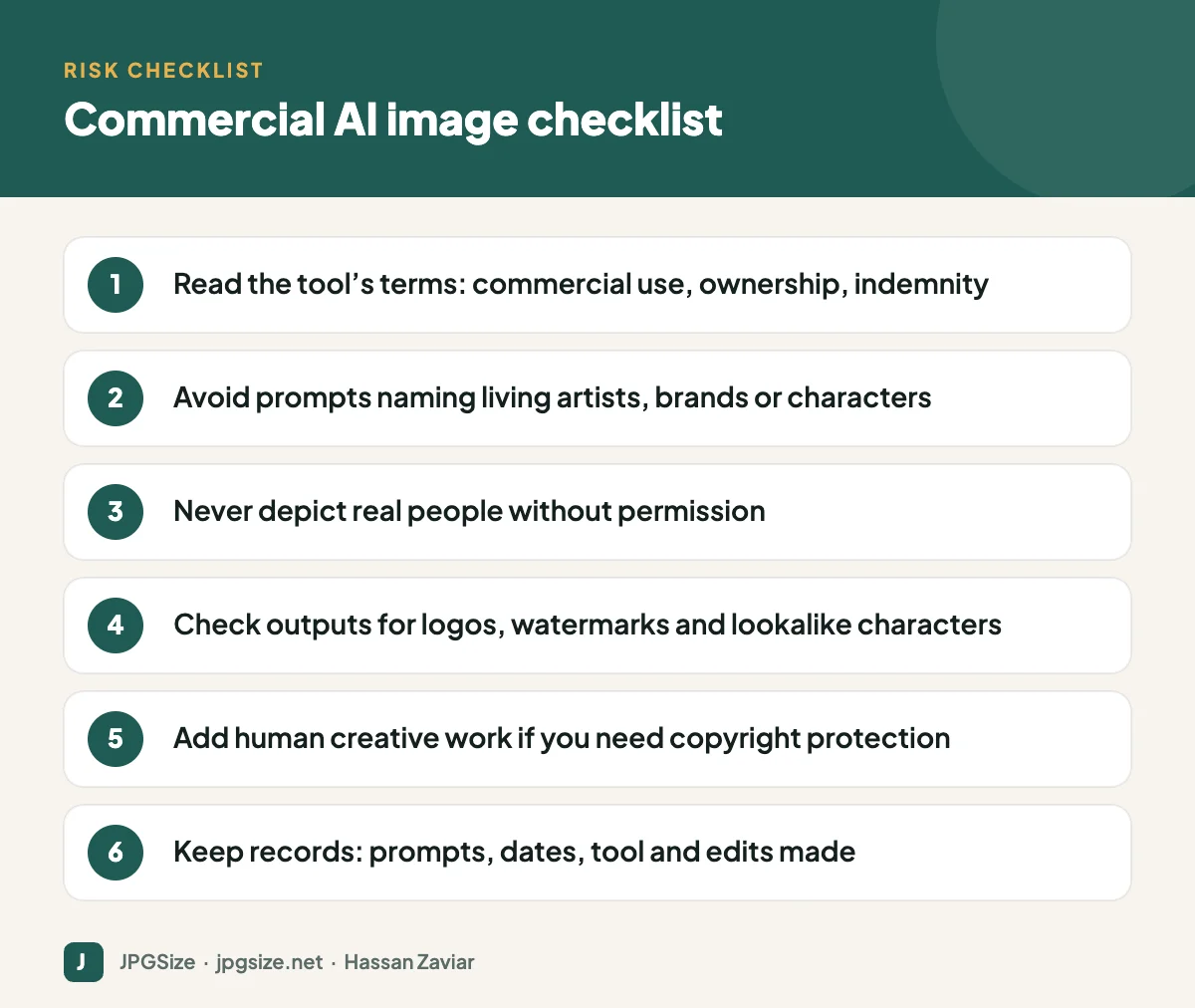
The largest practical risk is an output that closely resembles an existing copyrighted work or character. Prompts naming a famous character, a living artist’s style or a specific photograph increase that risk. If an output looks like something recognisable, do not use it.
Trademarks and logos
Generators sometimes produce logos, brand names or product designs that resemble real ones, or garbled watermarks from stock photo sites. Check every image, including backgrounds, at full size before publishing.
Real people
Creating realistic images of real people, including celebrities and your own employees, raises personality rights, privacy and defamation issues, and platform policies often prohibit misleading depictions. Get written consent for any identifiable person.
Misleading ads
Consumer protection rules apply to AI images like any other. Do not show product features, results or testimonials that do not exist. Some platforms require labels for realistic synthetic images, and provenance standards such as C2PA Content Credentials are becoming common; see how to spot AI-generated images.
How to strengthen your position
- Use AI as a starting point. Combine generated elements with your own photography, illustration, typography and layout. Human creative work is what copyright protects.
- Keep records of prompts, tool, plan, date and the edits you made. This helps show human contribution and good faith.
- Use tools with clear commercial terms and, for high-value campaigns, indemnity.
- Avoid naming artists, brands and characters in prompts.
- Review before publishing, with a simple approval step for anything used in paid media or on products.
- Label where required or where audiences would reasonably expect to know.
Frequently asked questions
Can I copyright an image made with AI?
In the United States, not the purely AI-generated parts. You may be able to protect your own contributions, such as edits, additions and the selection and arrangement of elements. Other countries take different approaches.
Can I sell products with AI-generated designs?
Often yes, if the tool’s terms allow commercial use and the design does not infringe existing copyrights, trademarks or likeness rights. Be aware that you may not be able to stop others from copying a purely AI-generated design.
Who owns an AI-generated image?
It depends on the law and the tool’s terms. Many tools assign any rights they have to the user, but where the law requires human authorship, there may be no copyright for anyone to own.
Is it legal to use AI images in advertising?
Generally yes, subject to the tool’s terms, advertising rules and platform policies. Avoid real people without consent, misleading depictions and anything resembling protected works or brands.
Sources and further reading
- U.S. Copyright Office: Copyright and Artificial Intelligence
- U.S. Copyright Office: Report on Copyrightability (Part 2), January 2025
- C2PA: Content provenance standard
About the author: Hassan Zaviar writes about image optimization, SEO, AI and digital marketing for JPGSize and works on the site’s free browser-based image tools. Last reviewed: 24 September 2026. Spotted something out of date? Tell us and we will update it.